
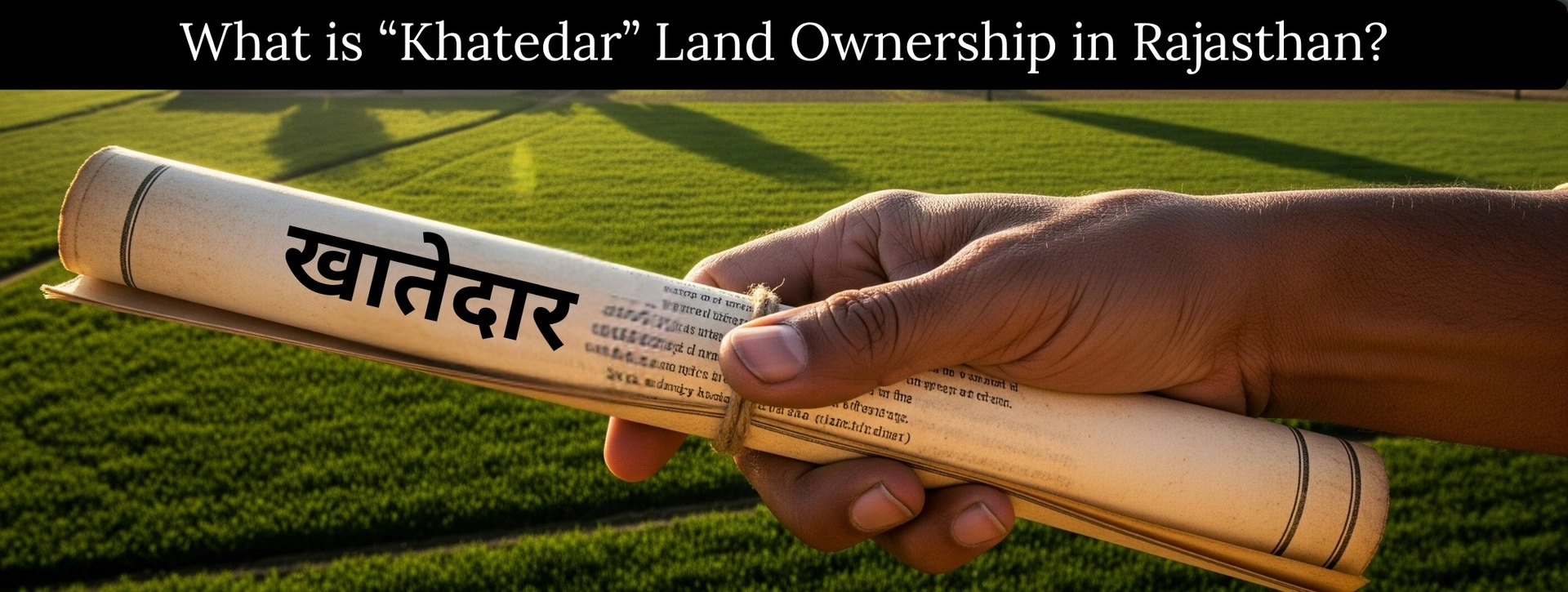
If you have ever tried to buy agricultural land in Rajasthan, you have probably heard people say, “Yeh khatedar zameen hai” or “Jamabandi me naam khatedar ke roop me chadha hua hai.” For a buyer, this one word “Khatedar” matters a lot, because it tells you who is legally recorded as the primary rights-holder of that agricultural land in the revenue records.
Let us break it down in simple, practical language so you can understand what it means, what rights it gives, and what checks you must do before paying even one rupee.
Khatedar meaning in simple words
In Rajasthan, a “Khatedar tenant” is a legally recognized category under the Rajasthan Tenancy Act, 1955. The Act lists different classes of tenants, including Khatedar tenants.
In real life terms, when someone is a Khatedar, it generally means:
- Their name is recorded in the land revenue records (like Jamabandi) as the main rights-holder for that khasra land.
- Their rights are usually heritable, meaning the land can pass to legal heirs.
- Their rights are generally transferable, but only under rules and restrictions laid down in law.
So yes, “Khatedar” is often treated like “owner” in everyday conversation, but legally it is better to understand it as the person with recorded khatedari rights in revenue records for agricultural land.
Where will you see “Khatedar” written?
You will mostly see it in land record documents like:
- Jamabandi Nakal (record of rights)
- Khasra details (parcel number details)
- Mutation / Namantaran history (name change entries)
In Rajasthan, many of these can be checked online through the government’s Apna Khata portal, where you can access Jamabandi copies and related record services.
What rights does a Khatedar have?
This is where buyers should pay attention. Under the Rajasthan Tenancy Act framework:
1) Inheritance rights
A Khatedar’s interest is treated as heritable, and the Act also talks about succession and bequest (will) for a Khatedar’s interest.
2) Transfer rights (sale, gift, bequest), but with conditions
The Act allows transferability of a Khatedar’s interest, but clearly says it is subject to conditions and restrictions (especially under sections like 42 and 43).
3) Mortgage for loans (in many cases)
The Act includes provisions where a Khatedar tenant can mortgage or hypothecate interest in the holding for loans from certain institutions, as permitted.
Reality check: Rights look strong on paper, but in land buying, your safety depends on records, category of land, and restrictions.
Important restrictions you must know (this is where deals go wrong)
A) Some lands cannot become Khatedari land
The Rajasthan Tenancy Act clearly mentions land categories where Khatedari rights shall not accrue, such as:
- pasture land
- land used for casual or occasional cultivation in the bed of river or tank
- land covered by water used for Singhara and similar produce
- land under shifting or unstable cultivation
This is why checking the land category in records is non-negotiable.
B) Restrictions on sale or transfer in certain cases (SC/ST protections)
The Act states that a Khatedar tenant’s sale, gift, or bequest can be void in specific restricted situations, including restrictions related to Scheduled Caste and Scheduled Tribe transfers (for example, SC to non-SC, ST to non-ST, with specific provisions).
If you ignore this and buy anyway, you are basically buying a future court case.
C) NRI and OCI angle (many people assume wrong)
If you are dealing with an NRI buyer (or you are an NRI yourself), note this clearly: RBI’s public FAQ on purchase of immovable property says NRIs and OCIs can purchase property in India other than agricultural land, farmhouse, plantation etc, and it also outlines what is permitted via inheritance and sale rules. (Reserve Bank of India)
So if someone says, “NRI buyer hai, farmhouse bhi le lega,” do not assume. Verify eligibility properly.
Khatedar vs Gair Khatedar (why buyers get confused)
Rajasthan land records may show different occupant or tenant types. Broadly:
- Khatedar is the stronger recorded right for agricultural holdings.
- Gair Khatedar generally indicates a different level of tenancy rights and may have different permissions and limits.
For a buyer, the key point is: Do not buy just because someone is “in possession.” Buy only when the recorded rights and the transfer are legally clean.
How to verify Khatedar land before buying (simple checklist)
Use this checklist like a habit:
- Match seller name with Jamabandi: The seller must be recorded as Khatedar (or lawful co-sharer).
- Check khasra numbers carefully: Same khasra in documents, same khasra on ground.
- Check mutation (Namantaran) trail: If inheritance happened, is the mutation done or pending?
- Check land category: Ensure it is not pasture land or other restricted category.
- Check transfer restrictions: Especially SC/ST related restrictions if applicable.
- Look for court disputes: Ask for a written declaration and also check locally through counsel.
- Ask about loans and mortgages: If any bank loan exists, take NOC.
- Verify boundaries and access: Road approach and boundary demarcation matter more than people think.
- Do an on-ground visit with local help: Patwari level clarity saves big losses later.
- Do proper sale deed registration and mutation: Registration alone is not the end. Mutation keeps records updated for future resale.
Common real problems people face with “Khatedar” land
- Jamabandi is old and mutation is not updated
- Land is joint family land, but only one person is trying to sell
- Khasra boundaries on ground do not match the paperwork
- Land category turns out to be restricted (like pasture or river-bed cultivation zone)
- Buyer ignores restrictions, and later the transfer is challenged
FAQs
Is Khatedar the same as full owner?
In daily language, people treat it like ownership. Practically, it means the person holds recorded khatedari rights in revenue records. But as a buyer, you should still verify title chain, restrictions, and land category before concluding it is “safe ownership.”
Can Khatedar land be sold?
Yes, Khatedar interest is transferable, but only within the legal conditions and restrictions under the Rajasthan Tenancy Act.
How can I check Khatedar details online in Rajasthan?
You can use Rajasthan government’s Apna Khata portal to view Jamabandi copies and land record services. Always cross-check with physical records for high-value transactions.
What land cannot become Khatedari land?
The Act lists categories where Khatedari rights shall not accrue, such as pasture land and some river-bed or water-covered cultivation categories.
Can an NRI buy Khatedar agricultural land in Rajasthan?
RBI’s FAQ indicates NRIs and OCIs can purchase land in India other than agricultural land, farmhouse, plantation etc, with specific rules for inheritance and sale. For any NRI transaction, take proper legal advice before proceeding.
Final takeaway
In Rajasthan, “Khatedar” is not just a word, it is the backbone of agricultural land credibility. If you are buying farmland, your safest approach is simple:
Jamabandi first, restrictions next, ground verification always, and documentation properly through registration and mutation.