
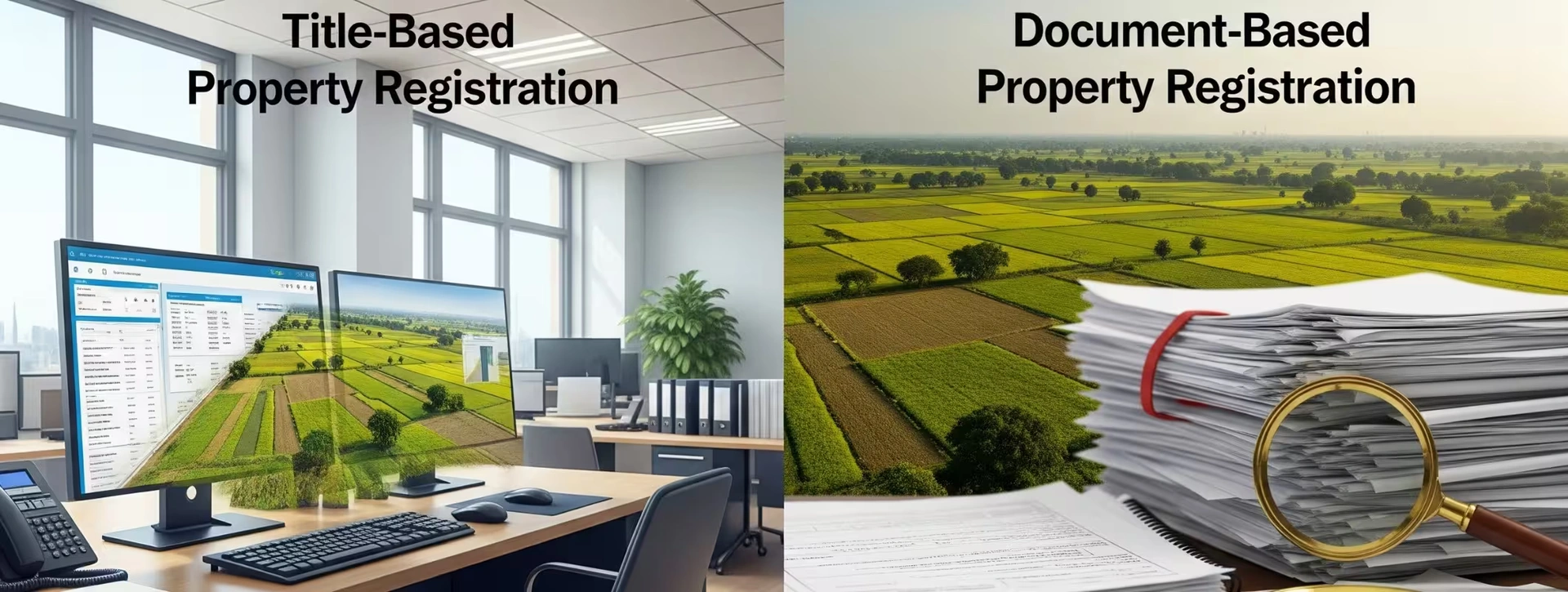
If you have ever heard someone say, “Registry ho gayi, ab property safe hai,” you already know the big problem in Indian real estate: registration proves the transaction happened, but it doesn’t automatically prove the seller actually owned the property cleanly.
That’s exactly what Uttar Pradesh is trying to fix with a title-based property registry / title-based property registration approach.
What is a title-based property registry in Uttar Pradesh?
In simple words, title-based property registry in Uttar Pradesh means:
The sub-registrar will register a sale only after verifying (using linked government records) that the seller is the lawful owner and the property is not carrying discrepancies or encumbrances that should block the transfer.
This is a shift away from the older “document-based registration” system where the department largely registers what the parties submit, without strong, system-level title verification.
Why UP is doing this now
UP has seen repeated cases of:
- impersonation sales
- multiple registries of the same property
- sale of disputed land or even government land
- long litigation because ownership records sit across different departments
Officials have openly acknowledged that the current loopholes have led to thousands of disputes, especially in high-value urban markets.
Document-based vs title-based registration: what changes on the ground?
1) The current model (document-based)
- Registration mainly confirms that a deed was executed and registered.
- It does not guarantee the seller had a “marketable title.”
2) The proposed UP model (title-based)
- The government plans to link ownership and property datasets with the registration system so sub-registrars can verify title before completing the registry.
- Expect “system checks” to catch mismatches early, not after fraud happens.
A legal expert quoted in ET sums it up bluntly: document registration proves a transaction took place; title-based verification reduces scope for forged documents, multiple sales, and hidden issues—because the government verifies title before registration.
How will title-based property registration work in UP?
The core idea is integration + instant visibility at the Sub-Registrar Office.
What UP is integrating
UP’s stamp and registration department is integrating its digital platform with:
- Board of Revenue land records (for rural land ownership data like khasra/khatauni)
- Urban local bodies’ property tax registers and other urban agencies (municipal bodies, development authorities, etc.)
Officials specifically mention API integration and property tax register integration to reduce fraudulent registrations.
What the sub-registrar will see
Once operational:
- For rural property, khasra number and ownership details should auto-appear on screen.
- For urban property, records from municipal and development authorities should show up for verification.
- Registry should proceed only after verification that the seller is the lawful owner and the property is free from discrepancies/encumbrances (as per system checks + officer validation).
Is this “conclusive title” like Torrens system?
Not fully (at least from what’s publicly reported so far).
A Torrens/conclusive titling system is where the government registers land and guarantees title conclusively.
India has been moving toward that direction via land record modernization goals. Program frameworks like DILRMP talk about upgrading records and working toward conclusive titling with title guarantees.
UP’s move looks like a strong step in that direction, but practically it is best understood as:
- title verification before registry (preventive control), rather than
- a blanket government guarantee of title for every property (true “conclusive title”).
Benefits for buyers, sellers, and the real estate market
For buyers (biggest win)
- Lower fraud risk: system checks reduce impersonation and duplicate sale attempts.
- Faster, clearer due diligence: ownership data becomes easier to verify at the registry stage.
- Higher confidence in transactions, especially in cities where record fragmentation creates confusion.
For genuine sellers
- Cleaner paperwork = smoother registry.
- Less “last-minute objection drama” when records already match.
For the market
- Better transparency reduces speculative chaos and improves financing confidence over time (banks love clean titles).
- It supports UP’s broader digitisation push like QR-based verification and faster title updates discussed publicly in the state’s Vision roadmap.
Reality check: what this system will NOT magically solve
This is important, because buyers in India often overtrust “government process.”
1) Data quality still matters
If land records or municipal records are outdated or wrong, a digital integration can also show wrong data—just faster.
2) Not all encumbrances are visible
A key caution noted by legal experts: buyers may still face risks from encumbrances created through documents that are not mandatorily registrable, so they may not show up in the usual registration-linked trail.
3) Disputes don’t disappear overnight
Title-based verification reduces new fraud, but legacy disputes, inheritance conflicts, boundary fights, and old litigation still need resolution mechanisms.
So yes—this reform helps, but don’t switch off your own due diligence.
Practical checklist: what you should do before registry in UP (even after title-based rollout)
Use this as your “minimum safety kit”:
Match seller identity and ownership
- Seller name must match land records / municipal records (don’t accept excuses like “family name difference” without proof).
Check land records properly
- For rural property, verify khasra/khatauni via revenue records (Board of Revenue land record services exist for this).
Ask for chain of title
- Previous sale deeds, gift deed, partition deed, inheritance documents—whatever built the ownership chain.
Encumbrance and litigation check
- Do not rely only on “seller says loan closed.”
- Ask your lawyer to do a basic search; encumbrance visibility can still be incomplete depending on how the charge was created.
Urban property: property tax and authority records
- Ensure tax records and authority records reflect the same owner and the same area.
What’s the timeline? When will it start?
Public reporting indicates the government has been working on safeguards and integration, and UP’s broader digitisation roadmap has talked about reforms and faster ownership updates with implementation targets around early 2026 in related initiatives.
Separately, UP’s registration tech stack has also been modernising (including infrastructure moves like cloud migration mentioned in news), which supports the operational backbone needed for such reforms.
FAQs
1) Is title-based property registry in Uttar Pradesh already live?
Reports describe it as a system UP is introducing/approving and building through data integration and verification workflows. The operational rollout depends on integration readiness and implementation orders.
2) Will title-based registration completely eliminate property fraud?
It will reduce a major category of fraud because the sub-registrar will verify ownership using linked records before registration. But it won’t erase risks like unregistered encumbrances, inheritance disputes, boundary disputes, or bad data in legacy records.
3) Does registry prove ownership in India today?
Not fully. Under the document-based regime, registration mainly proves a transaction occurred; it doesn’t guarantee the seller’s title is marketable. That’s the gap UP is trying to close.
4) Is UP moving toward conclusive land titling?
This reform aligns with the broader national direction of modernising land records and working toward clearer, more reliable titles. Conclusive titling (Torrens-type) is a more comprehensive model where the government guarantees title.
Bottom line
Title-based property registration in Uttar Pradesh is a big upgrade because it shifts the burden from “buyer beware” to “system verify first.” It won’t replace a good property lawyer, but it should make fraud harder, transactions cleaner, and ownership clarity stronger—especially in urban markets where mismatched records create daily chaos.