
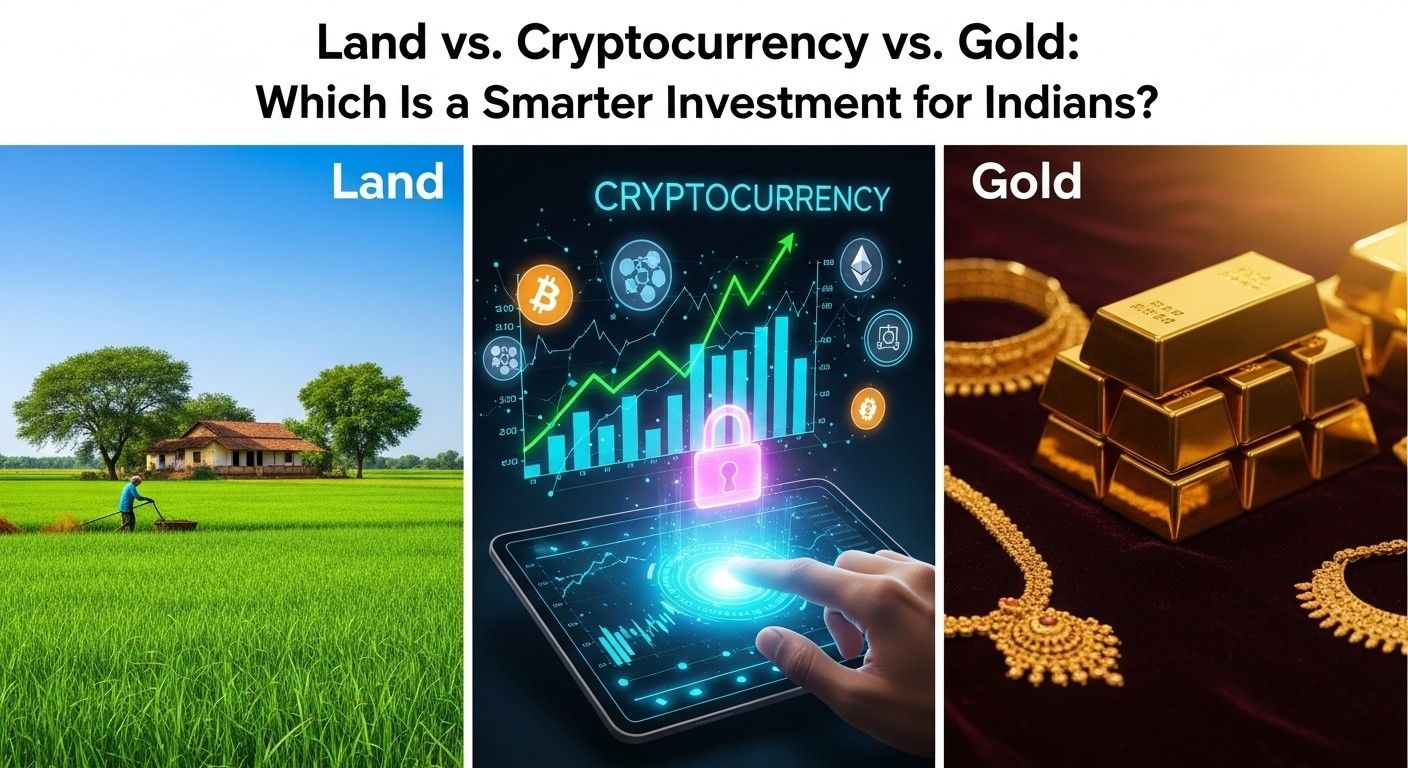
For Indian investors, land offers tangible ownership, scarcity, and the chance to create value through infrastructure-led appreciation and development—best held for 5–10+ years with proper due diligence or when you buy land online. Gold acts as a liquid, globally priced hedge against inflation and currency swings; Sovereign Gold Bonds add interest and tax-efficient maturity. Cryptocurrency delivers the highest upside—and the sharpest drawdowns—so treat it as a small, speculative sleeve only after core needs are secured. Think of it this way: make land your compounding core, keep gold as a stabilizing diversifier, and, if your risk appetite allows, use crypto for satellite growth—then rebalance with discipline.
If you’re weighing Land, Cryptocurrency, and Gold, here’s a simple way to frame the decision:
- Do you want a tangible asset that compounds quietly and builds intergenerational wealth? Land usually fits.
- Do you want a globally priced hedge that you can buy or exit quickly? Gold is your friend.
- Do you have a tiny, high-risk appetite for a moonshot? That’s crypto—handled with care.
What really drives returns?
Land (farmland, plotted land, industrial/highway belts)
- Scarcity + development: New expressways, airports, and logistics parks reprice surrounding land (the “infra multiplier”).
- Option value: Today agriculture/weekend use; tomorrow farmhouse, warehousing, subdivision, or participation in Land Pooling.
- Active value creation: Access roads, clear titles, utilities, and aggregation can materially lift value.
- Risks: Documentation gaps, zoning violations, access/RoW issues, illegal plotting, and slow exits.
Gold (SGBs, ETFs, physical)
- Global macro hedge: Tracks international gold prices and INR.
- Crisis/liquidity asset: Easy to sell (ETF) or pledge (physical/SGB).
- Risks: Premiums/discounts in secondary market SGBs, storage risk (physical), and tax treatment nuances across formats. RBI allows SGB early redemption after year 5 on interest dates; maturity at 8 years.
Cryptocurrency (Bitcoin/ETH and others)
- High beta to liquidity cycles: Returns largely tied to global risk appetite, network adoption, and regulation.
- 24×7, volatile: 10–30% swings in days are normal; position sizing matters.
- Indian tax drag: 30% flat tax on gains and 1% TDS above thresholds; no loss set-off or carry-forward.
Taxes, compliance & holding period (India)
Asset
|
Key tax points (India)
|
Holding / other rules
|
Land
|
If sold on/after 23-07-2024, long-term gains generally 12.5% without indexation. For land/building acquired before 23-07-2024 and sold after, resident individuals/HUFs may choose the old 20% with indexation or 12.5% without indexation, whichever is lower. Holding period for LTCG: 24 months. Buyer usually deducts 1% TDS under 194-IA if consideration or stamp duty value ≥ ₹50L. Possible exemptions: 54/54F (residential reinvestment), 54EC bonds.
|
Exit can take time (weeks–months). State-wise stamp duty, registration, circle rates apply.
|
Gold (SGB)
|
Interest 2.5% p.a. is taxable. Capital gains on RBI redemption at maturity are exempt. No TDS on interest; your responsibility to pay tax. Early redemption allowed after year 5 on coupon dates; SGBs trade on exchanges (liquidity varies).
|
8-year tenor; exit windows from year 5. Secondary prices can trade at a discount/premium.
|
Gold (Physical/ETF/Gold MF)
|
Budget 2024 rationalised LTCG to 12.5% without indexation for transfers on/after 23-07-2024 (asset-wide rule). Gold MFs/ETFs broadly taxed like debt funds unless equity-oriented rules apply. Recent rules removed indexation for many debt funds.
|
ETFs highly liquid; physical has making charges/storage risk.
|
Crypto
|
30% tax on gains + 1% TDS above thresholds; no deductions (other than cost of acquisition), no set-off/carry-forward of losses under 115BBH. TDS threshold ₹10k/₹50k depending on “specified person” status.
|
Unregulated asset class; policy can evolve. Keep detailed records; use compliant exchanges.
|
Note: The 12.5% LTCG change and the choice between 12.5% (no indexation) and 20% (with indexation) for property were notified via Budget 2024 updates and subsequent clarifications. The CBDT/ITD material confirms 24-month LTCG holding for immovable property and the property-tax choice, while separate circulars/tutorials cover 194-IA for buyer TDS.
Liquidity, volatility & costs (reality check)
- Land: Low-to-moderate liquidity; exit depends on parcel size, documentation, location, and market cycle. Transaction friction (stamp duty, registration), and diligence costs apply. For deals ≥ ₹50L (or where stamp duty value crosses ₹50L), buyer deducts 1% TDS under 194-IA.
- Gold: High liquidity via ETFs; moderate via SGB secondary market; SGB maturity is the cleanest tax outcome (redemption gains exempt).
- Crypto: Highest liquidity but also the highest volatility. The 1% TDS can affect high-frequency trading profitability.
Risk & compliance: what to actually verify
For Land (non-negotiables)
- Title chain & Encumbrance Certificate (EC) (ideally 30 years).
- Zoning & land-use (master plan), access/RoW, boundary survey, and mutation records.
- RERA (if applicable): Projects generally need registration when land area > 500 sq m or > 8 units; nuances vary by state, so cross-check local RERA clarifications.
- State-specific farmland rules: Some states restrict non-agriculturists/NRIs from buying agricultural land; regulations evolve. NRIs are generally prohibited from buying agricultural land under FEMA. Always seek local legal advice.
For Gold
- Prefer SGB or ETF for clean documentation and exit. Know SGB premature-redemption windows and that maturity redemption is tax-exempt for individuals.
For Crypto
- Keep precise trade logs; factor in 30% tax, 1% TDS, and no loss set-off while sizing positions.
Format choices within each asset
Land Investment (via 2Bigha)
- Freehold parcels: Farmland, industrial/highway belts (long-term appreciation, potential lease income).
- Land Pooling: Contribute land into a planned development; receive fully serviced lands or revenue share when infrastructure is built.
- Fractional/structured options & Property tokenization: Where regulations and structures permit, exposure via SPVs or real estate tokenization (careful legal vetting required).
Gold
- SGBs: 8-year tenor, 2.5% interest, tax-exempt maturity gains; early exit after 5 years on interest dates; exchange tradability varies.
- ETFs/Gold funds: Liquid; taxed akin to debt-type funds post-reforms (LTCG 12.5% without indexation generally).
- Physical: Useful for pledging; factor making charges, storage, purity risk.
Crypto
- Blue-chips (BTC/ETH): Higher relative quality; still volatile.
- Altcoins: Treat as speculation; many fail across cycles.
- Custody: Prefer reputable exchanges and consider cold storage for meaningful sums.
When does each asset shine?
- Pick Land if you want to create value (roads, utilities, aggregation), ride infra corridors, and hold long enough to realise planning outcomes.
- Pick Gold if you want liquidity + hedge and clean tax outcomes via SGB maturity.
- Pick Crypto if you can tolerate severe volatility, accept the Indian tax regime, and keep it as a small satellite.
Practical tax notes you shouldn’t ignore (India)
- Property sold on/after 23-07-2024: Long-term capital gains are 12.5% without indexation by default. For land/building purchased before 23-07-2024, resident individuals/HUFs may choose 20% with indexation if it’s lower than 12.5% without indexation. LTCG holding period for immovable property: 24 months.
- Buyer TDS: 1% under Section 194-IA when consideration or stamp duty value ≥ ₹50 lakh (higher of the two).
- SGBs: Interest taxable; redemption capital gains exempt; no TDS on interest (your responsibility to pay tax).
- Gold ETFs/Gold funds: Post-reforms, most non-equity funds are taxed like debt; indexation benefits removed for many categories; check acquisition dates and AY 2025–26 rules.
- Crypto: 30% tax; 1% TDS (₹10k/₹50k thresholds) and no loss set-off/carry-forward under 115BBH.
How 2Bigha makes Land Investment simpler
If you’re serious about Property Investment, we help you go beyond listings:
- Verified inventory: Title checks, Encumbrance Certificate review, mutation/status verification, and zoning/land-use screening—so you aren’t blindsided later.
- Corridor intelligence: We map projects to expressway/airport/industrial-belt plans and surface Land Pooling opportunities where applicable.
- Deal formats: Buy freehold parcels, participate in pooling, or (where eligible and compliant) explore land tokenization/real estate tokenization/Property tokenization structures with clear SPV governance.
- Exit readiness: Parcel sizing, access improvement, and documentation kits to speed up future resale.
- Marketplace support: Search Land, Buy lands in India, or sell land in India with guided workflows.
FAQs
1) Is land always better than gold or crypto?
No single asset fits all situations. Land is powerful for long horizons and value creation, gold is a liquidity/hedge, and crypto is speculative. Many Indian families blend all three, land as core, gold as diversifier, crypto as small satellite.
2) What’s the cleanest way to hold gold for taxes?
If you can hold to maturity, SGB is compelling: 2.5% interest (taxable) + capital-gains-free redemption at 8 years; early exit allowed from year 5 on interest dates.
3) How are property long-term gains taxed now?
Transfers on/after 23-07-2024: 12.5% without indexation generally. For land/building bought before 23-07-2024, resident individuals/HUFs can choose 20% with indexation if it’s lower. LTCG holding period: 24 months.
4) Do I need to deduct TDS when buying property?
If consideration or stamp duty value ≥ ₹50 lakh, the buyer deducts 1% TDS under Section 194-IA.
5) What makes land risky and how do I reduce risk?
Title defects, encumbrances, zoning violations, access disputes, or non-RERA-compliant plots. Mitigate with title/EC checks, boundary surveys, RERA verification (where applicable), and local legal counsel.
6) What should I know before buying farmland?
Rules differ by state; NRIs generally cannot purchase agricultural land under FEMA; some states restrict non-agriculturists. Verify eligibility before you transact.
7) What’s the current crypto tax in India?
30% on gains plus 1% TDS (₹10k/₹50k thresholds); no loss set-off or carry-forward. Size positions accordingly.
The bottom line
- If your family values capital safety, tangible ownership, and multi-decade compounding, put Land Investment at the heart of your plan and be ruthless about due diligence.
- Keep Gold as a steady hedge—SGB if you can commit to tenure; ETF if you need liquidity.
- Treat Crypto as a small, speculative sleeve after you’ve secured your core holdings and emergency fund.
When you’re ready, 2Bigha can help you Search Land, shortlist vetted parcels, understand Land Pooling options, or structure a compliant pathway for Property tokenization/Asset Tokenization (where appropriate). Let’s design a Property Investment strategy that fits your horizon, risk tolerance, and cash flows, not internet hype.
This blog is for educational purposes only and does not constitute investment, legal, or tax advice. Laws, rules, and rates may change; please consult a SEBI-registered advisor and tax professional for personalised guidance. 2bigha does not claim or guarantee any statistics and is not responsible for the data or figures mentioned. Readers should treat this as informational only, ensure compliance with laws, and independently verify actual values before taking any step.