
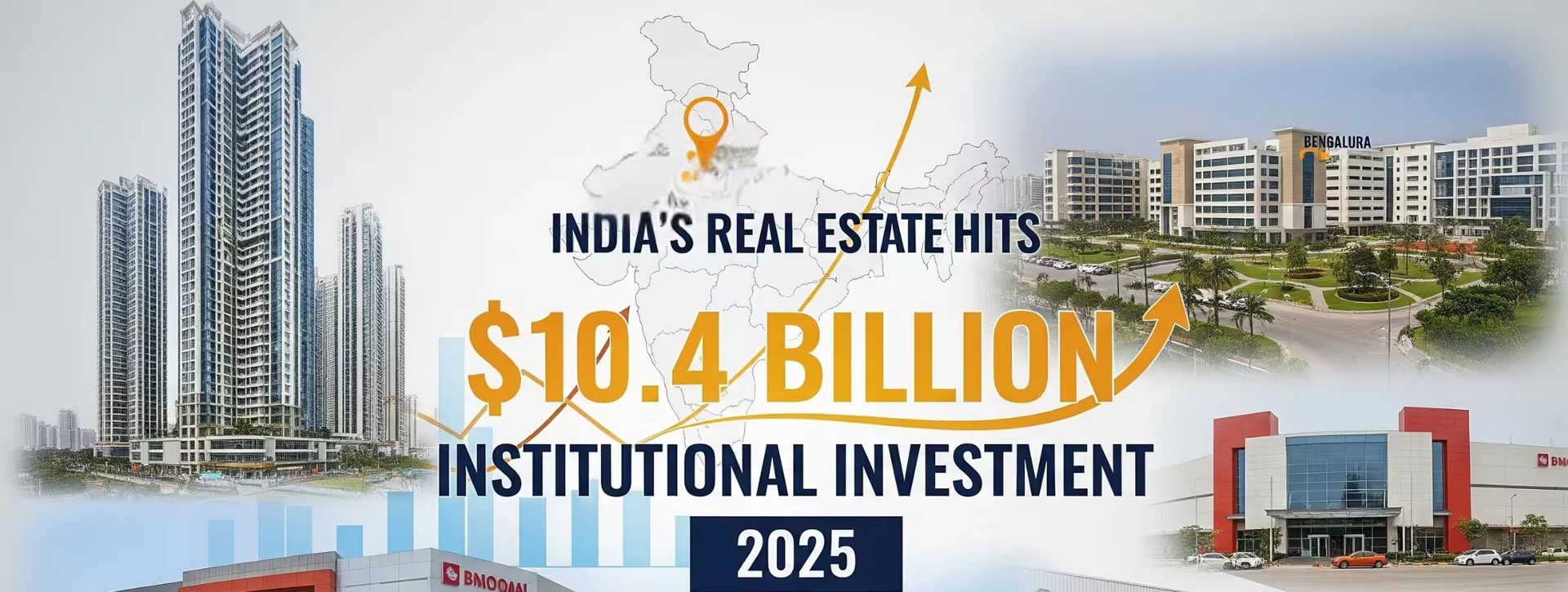
India’s real estate story just crossed a serious milestone. In 2025, institutional investments touched $10.4 billion across 77 transactions, the highest ever recorded so far.
This is not just a “big number” headline. It signals something deeper: India is moving from a foreign-capital-led real estate market to a more balanced, mature ecosystem where domestic institutions are now driving the engine.
Let’s unpack what happened in 2025, what drove the money, and what it means for developers, investors, and even end-buyers watching the market.
Quick snapshot: the numbers that matter
Here are the key highlights you should know:
- Total institutional investment (2025): $10.4B across 77 deals
- Domestic capital share: 52%, first time domestic investors led since 2014
- Office sector investment: $6B, with 58% share of total institutional deployment
- Equity-led investing: 83% of total institutional investment (shows long-term intent, not short-term leverage plays)
- Platform commitments: $11.43B for the next 3–7 years, with about $11B tied to the Digital Connexion data-center platform
- Bengaluru led the chart: 29% of total deployment; Tier II cities still small but growing with $175M
What is Institutional Investment in real estate?
Institutional investment means large, professional capital entering real estate through structured deals, such as:
- private equity and real estate funds
- pension, sovereign, and global asset managers
- REITs and InvITs
- platform plays (long-term capital commitments to build and scale assets)
This kind of money typically chases quality, compliance, stable yields, and predictable exits. When institutional money grows, the market
usually becomes more organised and less speculative.
The biggest shift in 2025: India’s domestic capital finally took the lead
The headline of 2025 is not only “record investment”. The real headline is this:
Domestic investors captured 52% market share, a first since 2014
This is a structural shift, not a seasonal trend.
What powered this?
- REITs and InvITs deployed $2.5B, contributing 56% of core asset acquisitions
- Indian private equity also stepped up, adding depth to domestic deployment
This matters because when domestic institutions grow, India becomes less dependent on global risk moods. Even if foreign investors slow down due to global rates or uncertainty, domestic capital can keep the market moving.
Office sector made a comeback and grabbed the biggest share
In 2024, residential-led activity had stronger visibility (many reports show residential was a larger share then).
But in 2025, institutional money clearly said: “Give us cash-flowing office assets.”
Office investments reached $6B and captured 58% share
Even more important: nearly two-thirds went into stabilised, income-generating core assets, which shows investors are prioritising predictable rental yield and long-term security.
One big reason is the continuing build-up of India as a global services and capability hub. The Economic Times report also links investor confidence to GCC growth, infrastructure push, and exit visibility through REITs.
Foreign investors didn’t disappear, they just became more selective
Yes, the share of foreign investment reduced, but the reality is more interesting:
- Foreign capital deployment still grew 18% YoY in absolute terms
- Americas-based investors jumped from $1.6B (2024) to $2.6B (2025)
That tells you global investors are not “leaving India”. They are simply focusing on prime core assets, strong partners, and clearer risk-return profiles.
The silent giant: platform commitments crossed $11.43B
Direct deals are only one part of the story. The bigger long-term confidence signal is platform commitments.
Platform commitments touched $11.43B, mostly driven by data-centre scale-up
A major chunk (around $11B) is linked to Digital Connexion, a joint venture between Reliance, Brookfield, and Digital Realty to develop data centres.
This aligns with the broader AI and digital infrastructure wave. Reuters also reported the same JV’s $11B investment plan for building AI data capacity and a large data centre campus.
In simple terms: Real Estate is no longer only homes and offices. Digital infrastructure is now a big institutional theme.
Emerging asset classes are getting real attention
2025 also showed stronger diversification into newer segments like:
- data centres
- student housing
- life sciences
- healthcare real estate
These assets typically sit at the intersection of “real estate + demographic demand + long-term leasing”. That combination is exactly what long-horizon institutions like.
Which Cities are winning institutional money?
Institutional capital is not spreading evenly across India (yet). It is going where leasing, demand depth, and exit options are strongest.
- Bengaluru led with 29% of total deployment
- Mumbai-MMR stayed strong due to premium commercial assets and headquarters concentration
- Tier II cities are still early but recorded $175M institutional deployment
So if you are a developer or landowner, you can buy land in Tier II location, the message is clear: institutional money will come only when the product is institutional-grade (clear titles, compliance, scalable demand, and professional operations).
What this means for 2026 and beyond?
Here’s the forward-looking truth: institutional capital is getting smarter, and it is getting picky.
If you are a Developer
- Build assets that can be REIT-ready (strong leases, clean compliance, stable operations)
- Focus on core and core-plus quality, not just quick flip inventory
- Start thinking of emerging sectors (data centre ecosystem, healthcare, student living) as real verticals
If you are an Investor (including NRIs)
- Don’t get blinded by hype. Follow where institutions are going: prime office, stable income assets, and platforms
- Watch REIT market expansion closely; it’s a key exit and liquidity pathway
If you are a Buyer
Institutional money flowing into office, infrastructure, and premium assets usually pushes cities toward better quality supply, better governance, and stronger rental ecosystems. It doesn’t automatically make every micro-market a “sure-shot”, but it does improve the overall market depth.
FAQs (Frequently Asked Questions)
1) Why is $10.4B institutional investment a big deal?
Because it reflects peak confidence and structured capital deployment, and it signals that India is becoming a priority market for long-term real estate investment.
2) What does “domestic capital at 52% share” mean?
It means Indian institutions (REITs, InvITs, domestic funds) contributed more than foreign investors for the first time since 2014, which shows market maturity.
3) Why did the office sector attract the most investment in 2025?
Because offices delivered institutional-grade income stability, and investors preferred stabilised, leased, core assets.
4) What are “platform commitments”?
They are long-term capital commitments (often multi-year) to build and scale a real estate platform, like data centres or large commercial portfolios. In 2025, platform commitments touched $11.43B.
5) Which city got the most institutional real estate investment in 2025?
Bengaluru led with 29% of total institutional deployment.