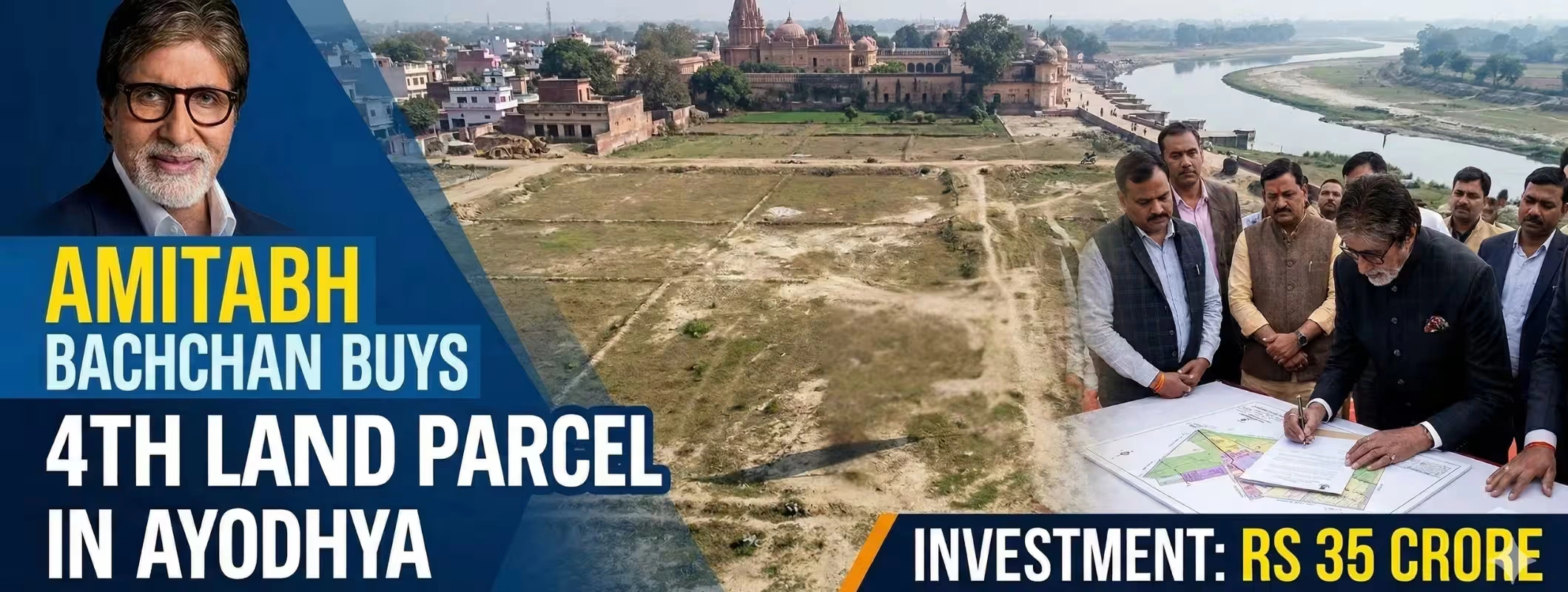
Ayodhya is no longer being discussed only as a spiritual destination. It is now being tracked as a serious real estate market. Amitabh Bachchan’s latest land purchase in the city has again pushed Ayodhya real estate into the spotlight and raised a bigger question for ordinary buyers: is this the right time to invest in land in Ayodhya?
Key Takeaways
- Amitabh Bachchan has reportedly bought a 2.67-acre land parcel in Ayodhya for Rs 35 crore, near HoABL’s premium project, The Sarayu. Reports say this is his fourth investment in Ayodhya overall and his third through HoABL.
- Ayodhya’s investment story is being driven by religious tourism, infrastructure spending, premium plotted developments, and rising benchmark land values.
- This deal matters because it signals that large-ticket investors still see long-term upside in Ayodhya property investment, especially around branded and strategically located land parcels.
- For regular buyers, the lesson is not to copy celebrity buying blindly. The real opportunity lies in clean-title land, good access, realistic pricing, and exit potential.
Amitabh Bachchan’s latest Ayodhya land deal
According to recent reports, Amitabh Bachchan has purchased a 2.67-acre plot in Ayodhya for Rs 35 crore. The parcel is located near The Sarayu, a luxury plotted development by the House of Abhinandan Lodha. Reports also say the transaction was executed by Rajesh Yadav, Managing Director of AB Corp Ltd, and that registration authorities confirmed the property registration.
This is not his first Ayodhya purchase. Earlier reporting linked him to a 10,000 sq ft plot in The Sarayu in 2024 for around Rs 14.5 crore, followed by additional Ayodhya-linked purchases in 2025, including a 25,000 sq ft parcel near The Sarayu for nearly Rs 40 crore. That is why this latest transaction is being described as his fourth Ayodhya investment.
That pattern matters. One-off celebrity purchases create headlines. Repeated purchases create a market signal.
Why this deal matters for Ayodhya Real Estate
The headline is not just about a Bollywood icon buying land. The real story is that Ayodhya is seeing continued interest from premium buyers even after the first wave of Ram Mandir-led excitement. In simple words, this is not just emotion-driven buying anymore. It is increasingly becoming a location-based, infrastructure-backed land investment story.
The Uttar Pradesh Budget for 2026-27 allocated Rs 150 crore for tourism infrastructure in the Ayodhya region, while official reporting also noted that Ram Path is nearing completion and road upgrades are underway toward the proposed Vedic Wellness City at Jamthara. That tells buyers one important thing: public investment is still flowing into the city.
At the same time, Ayodhya’s property economics are changing. Reporting from 2025 said the district administration revised circle rates after years of no revision, with residential benchmark values in prime areas rising about 10% to 40% on average, agricultural land on the outskirts rising 10% to 30%, and commercial values increasing 20% to 50%. In a rising market, stamp duty, entry cost, and replacement cost all start moving upward.
Connectivity is another part of the story. The Airports Authority of India lists Maharshi Valmiki International Airport, Ayodhyadham as the city’s airport, reinforcing Ayodhya’s growing accessibility and investor appeal.
Why high-value Buyers are still looking at Land in Ayodhya
Large investors usually do not enter a market only because it is trending. They look for a mix of narrative, infrastructure, liquidity, and future demand. Ayodhya now has all four.
First, it has a strong emotional and cultural pull. That creates steady visitor demand and keeps the city in national conversation.
Second, it has an improving infrastructure base. Airport access, road upgrades, and tourism spending reduce the gap between a pilgrimage city and an investable real estate market.
Third, branded developments are reshaping buyer confidence. HoABL’s Ayodhya project is being marketed as The Sarayu Reserve Ayodhya, with premium residential plots and villas. Premium plotted developments often attract investors who want cleaner documentation, better layout planning, and a more structured resale narrative than fragmented local land deals.
That is why Amitabh Bachchan’s Ayodhya land purchase is being read as more than a celebrity move. It reinforces the view that Ayodhya property investment is shifting from speculative chatter to strategic land banking.
What ordinary Buyers and Investors should learn from this
Here is the blunt truth: most buyers should not copy celebrity investments parcel-for-parcel. A Rs 35 crore land deal and a retail buyer’s land purchase are not the same game.
A celebrity can buy for legacy, branding, philanthropy, privacy, or long-term capital parking. A regular investor usually buys for appreciation, resale, rental potential, or future development. So the right takeaway is not “buy where a celebrity bought.” The right takeaway is “understand why that micro-market is getting attention.”
If you want to buy land in Ayodhya, focus on these five practical filters:
1. Check title clarity before checking appreciation potential
A fast-rising market attracts both genuine opportunity and messy inventory. Clean ownership history, mutation status, access rights, and land-use clarity matter more than a glossy brochure.
2. Don’t confuse circle rate with real market value
Circle rates affect registration and stamp duty, but actual market pricing can move differently. In hot corridors, the gap between government value and asking value can be huge.
3. Prioritise location logic, not just temple proximity
Land near major access roads, planned tourism belts, hospitality corridors, and organised developments may perform better than parcels bought only because they are “close to a famous landmark.”
4. Ask what the exit story looks like
Who will buy this land from you after three to five years? Another investor? A local end user? A hospitality player? A developer? If you cannot answer that, the investment case is weak.
5. Factor in holding cost and timeline
Land is not always a quick-flip asset. In many cases, the real return comes from patience, infrastructure completion, and market maturity.
What is 2Bigha and how it helps Buyers and Investors
For buyers and investors who want to explore land opportunities more systematically, 2Bigha is a land-focused platform built around discovery, market visibility, and easier access to property information.
On its main platform, 2Bigha says users can search lands anywhere, explore listings on a map, and access current land prices, investment opportunities, land ownership records, and property insights to make more informed decisions. That directly helps buyers who do not want to rely only on broker talk or random local references.
For investors, 2Bigha also offers an investment plan that presents a fractional real estate model. The platform says users can buy shares in curated land or property opportunities, with returns linked to rental income and appreciation. For people who want exposure to real estate without taking on the burden of full ownership, that can be a useful entry route.
For sellers and landowners, 2Bigha’s sell page highlights features such as Post Property Free and the option to share land details via WhatsApp for listing support. That improves listing reach and can help bring more organised supply into the market.
In simple terms, 2Bigha can help buyers and investors in three ways:
- it makes land discovery easier,
- it adds market context through pricing and property insights,
- and it gives investors another route through curated investment options.
Is Ayodhya still a good place to invest in land?
Yes, but only if you invest with discipline.
Ayodhya still looks attractive because the city has strong long-term demand drivers: religious tourism, infrastructure spending, better connectivity, and growing visibility among premium and organised developers.
But that does not mean every plot in Ayodhya is a good investment. Markets that rise quickly also attract overpricing, weak documentation, poor access parcels, and unrealistic return promises.
A better strategy is to look for:
- legally clear land,
- strong road access,
- future usability,
- realistic entry pricing,
- and a neighbourhood that can support resale or end use.
That is how serious investors approach land. And that is the real lesson hidden inside the Amitabh Bachchan Ayodhya land news.
Final word
Amitabh Bachchan’s Rs 35 crore Ayodhya land deal is not just celebrity real estate gossip. It is another sign that Ayodhya real estate continues to attract high-conviction capital. Reports point to a market supported by faith-driven demand, public infrastructure spending, premium plotted development, and rising land benchmarks.
For ordinary buyers, the opportunity is real, but only when backed by due diligence. Do not chase headlines, Chase clarity. In a market like Ayodhya, the winners will not be the fastest buyers. They will be the smartest ones.
Frequently Asked Questions (FAQs)
Why did Amitabh Bachchan buy land in Ayodhya?
Reports do not state his exact personal reason, but the purchase fits a broader pattern of repeated investment in the city, especially near premium developments such as The Sarayu. That suggests continued confidence in Ayodhya’s long-term real estate potential.
How much is Amitabh Bachchan’s latest Ayodhya land deal worth?
Recent reports say the latest purchase is worth Rs 35 crore for a 2.67-acre parcel near HoABL’s Ayodhya project.
Is Ayodhya property a good investment in 2026?
Ayodhya remains attractive because of ongoing tourism and infrastructure push, but returns will depend on title clarity, location, pricing, and usability of the parcel. The market has momentum, but buyers still need strict due diligence.
How can 2Bigha help in Ayodhya property search?
2Bigha says it helps users search land, explore map-based discovery, check land prices and property insights, and even access fractional investment options for curated opportunities.
Disclaimer: This image is for illustrative and informational purposes only. It represents news reports related to land investment in Ayodhya.